
What is search intent? It refers to the reason behind a user’s search. It is the “why” that motivates someone to enter a query in Google.
Imagine three people searching for the keyword “pizza”. One needs a recipe. Another is hungry and needs food delivery. The third is interested in knowing how pizzas originated. Same keyword but different intentions. Google tries to understand the needs of every searcher, and your blog post must cater to them.
So, what is search intent in layman’s terms? It refers to the goal a user wants to achieve through a search. And when your post caters to it, then only do you stand a chance to rank. Otherwise not.
In this guide, I’ll explain what is search intent and why it matters for SEO, step by step. This post is part of my SEO fundamentals beginner’s guide. I touched on intent in my posts on how to write an SEO blog post and the on-page SEO checklist. Here, we go deeper.
What Is Search Intent? A Simple Answer
Search intent helps us understand what people are really looking for when they type a query into a search engine. This term is also known as user intent or keyword intent. These are the same.
Imagine yourself as a waiter taking an order from a client: “Something light.” A good waiter asks what he really wants. But Google cannot ask. So it tries to guess the goal and show the relevant pages.
This is a brief explanation of the question “What is search intent?” This is the goal. The search keywords are just the clue.
Why does it matter to you? Understanding what users need helps you create content that matches their search intent.You’ll also know which information to leave out.
Two searches can be quite similar but require completely different pages. Let “Keyword research” be your topic.The first visitor wants to understand what it is. The second one wants to compare the tools for doing it. The third one wants a step-by-step methodology. People may search for the same topic for different reasons, so your content should match what each person needs.
What Is Search Intent and Why Is It Important for SEO
Google wants to display useful content. Even the best-written content won’t be useful if it doesn’t answer what users are searching for.
Imagine you have searched for an “on-page SEO checklist.” You are expecting some kind of checklist that you could follow. Then you publish a lengthy essay on the history of SEO. Though the keywords match, the goal fails.
That’s why I always make sure I have gone through page one of Google before starting any writing. And it just takes me a couple of minutes. This approach also helps me save a lot of time.
Aligning with intent will also benefit your readers. They get the content they are looking for in no time. Your blog becomes more reliable for them next time they come searching.
So, the real question is not simply “What is search intent?” It’s also, “Am I giving my readers the content they are searching for?”
That’s why you should ask yourself, “What is search intent?” before you start planning any post. And you need only a couple of minutes.
What Is Search Intent? The 4 Main Types

In SEO, search intent is divided into four main types. Each one requires a unique post. We will now look at each of these types of search intent individually.
Informational Intent
The searcher is looking for information. For example, a user might search for “What is search intent?” or “How to write a meta description.” The most appropriate form of content for this purpose is a guide.
Navigational Intent
The searcher is trying to reach a certain website or web page. Ranking for searches like ‘Google Search Console login’ is difficult unless your website is the official one, because users want to reach the brand directly. So, do not target them.
Commercial Intent
The searcher is comparing his/her options. For instance, “Best free keyword research tools.” Comparison articles, reviews, and list-based posts help readers find the information they’re looking for. This is where my post about free vs paid keyword research tools fits in.
Transactional Intent
When users are ready to buy or sign up, they search for terms like ‘Buy SEO course’ or ‘Keyword tool pricing.’ Product pages, pricing pages, and signup pages are the best ways to meet their needs.
Some searches combine intents. “Best SEO course near me” is commercial and local at once. This is quite typical. When there is mixed intent, go to page one. It will show what Google likes.
If you work with local businesses, pay attention to local intent. Search queries such as “plumber near me” require something close by rather than an extensive guide. In such cases, a local page or a well-maintained business page will be more appropriate than a blog post.
The search ‘What is keyword research?’ shows informational intent because the user wants to understand the topic. “Best keyword research tools” is commercial. The search “Keyword research tool pricing” shows transactional intent. The same subject area but different intentions.
Understanding the four types of search intent helps you discover what users want when they search for a keyword.
What Is Search Intent? How to Spot It in Google
It doesn’t require any paid software for this. It requires only your eyes.
First, enter your keyword in Google. Next, examine the website’s ranking on the first page of Google. Can you see guides, lists, product pages, or videos? Copy the structure but don’t copy the words. Third, check out the additional boxes.If you see a “People Also Ask” box in Google search results, it may be a sign that users want to learn more about the topic. Map – local goal. Shopping – purchasing goal.
Next, look closely at the words users type into Google. Certain words are the clues to:
| Words in the search | Likely intent | What to write |
| what is, how to, guide | Informational | Explainer or how-to |
| best, vs, review, top | Commercial | Comparison or list |
| buy, price, discount | Transactional | Product or pricing page |
| login, brand name | Navigational | Skip, unless it’s your brand |
| near me | Local | Local page or listing |
Finally, there is one more free hint available in your own Google Search Console Performance report. This report reveals real-life queries responsible for bringing impressions to your pages. Study them like feedback from your audience – this will give you an insight into what people really need from you. Another opportunity to define search intent for your blog!
Try now with “what is search intent”. “What is” tells us about the intention to acquire knowledge. So the right reply will be an explanatory one – just like this one.
What Is Search Intent? How to Match It in Your Blog Post
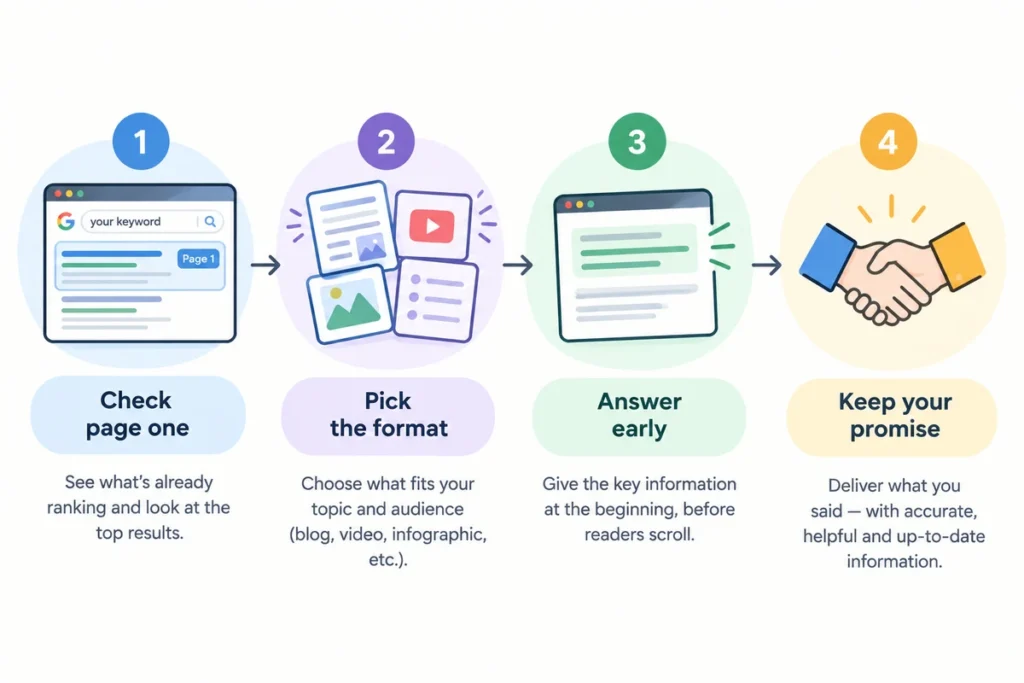
Now apply it. Let’s say your keyword is “what is search intent”. Page one has explainers that have a definition, types, and examples of search intent. Therefore, your post should also include all these elements. Include a short answer to the question. Include the types. Then include the examples. This is the structure of this post.
There are four actions you can always repeat:
- Pick the proper format. In case page one contains checklists, write a checklist.
- Answer the question early. Answer the main question within the first paragraphs. People who come for information don’t want to wait.
- The depth should be the same. People looking for an easy answer don’t need anything else than that.
- Keep your promises. Titles and meta descriptions should contain what your post has. If there are five steps in the title, make sure there are five steps in the post.
Where does this stage fit in the process? It comes first. In my guide on how to write an SEO blog post, you can see the entire process, and in the on-page SEO checklist, you will find information about titles and meta descriptions.
Additionally, have one purpose per post. A page trying to be all things for everyone is nothing for anyone. This is why pillar and cluster pages are so effective. The pillar provides the overall context. The clusters have their specific purposes. I elaborate on that in my pillar and cluster content guide.
What Is Search Intent? Common Mistakes
I notice the same mistakes beginners make all the time. Be sure to avoid these:
- Assuming rather than verifying. Always check the page one results first.
- Using the wrong type of content. The list format is better if everyone else uses lists.
- Trying to hit the buying term with a blog post. You’re unlikely to succeed if page one consists entirely of product pages.
- Failing to recognize mixed intent. Sometimes the search requires two types of content.
- Switching topics midway through. A guide turns into a sales pitch, losing the reader’s attention.
- Writing for Google and not for the user. Always start from the reader’s needs. Everything else comes afterwards.
- Never review again. Page one changes with time. Always review when updating the content.
Google asks for helpful, people-first content. Matching intent is the first step to being helpful.
What Is Search Intent? FAQs
What is search intent in simple terms?
It is the purpose of the search. It is the knowledge, product or service that a user is seeking after typing certain words in Google. The words are just hints, but the actual goal is much deeper.
What are the four kinds of search intent?
The four types of search intent include informational, navigational, commercial, and transactional. Informational refers to searching for knowledge. Navigational refers to seeking a particular website. Commercial refers to the comparison of products. And, transactional refers to the intention to make a purchase.
Is search intent a ranking factor?
Google does not announce “search intent” ranking factors or scores. However, Google’s mission is all about providing users with what they need. That is why an article that aligns with their goals wins. Otherwise, it won’t rank high despite the best content on the web.
How do I know the search intent behind a keyword?
Perform the search on Google and examine the results on page one. See the formats. Are these guides, listicles, product pages or videos? And then, look at the wording on the search results page and all its boxes, such as “People also ask”. Mimic the format but not the wording.
Can there be several search intents behind one keyword?
Yes. This is known as mixed intent. The keyword “best SEO course near me” is both commercial and local. In cases like that, examine the page one results to see what pages Google prefers and deliver on the main intent first.
Is search intent the same as the keyword?
No. The keyword is the wording the person uses for his or her search. Search intent is the motive. Two people may use the same keyword for different purposes.
How frequently should I examine the search intent?
Once before creating a new post and once more when I’m updating an existing post. The results on page one may vary.
What Is Search Intent? Final Thoughts
Now, just put it in a nutshell. So, what is search intent? Search intent means the intent behind the search. It has four types: informational, navigational, commercial and transactional. The intent is determined on the first page. Then comes the part where you have to relate it to the right format, an instant solution and the correct title.
For today, I will give you one little task. Pick one of your blogs. Run a search on Google using the keyword. Are your posts like the posts on the first page? If not, then here is another fix for you.
Answer “What is search intent?” and all your future blogs will become easier for you.
Now, come back and tell me what you have learned.
Pingback: 7 best SEO Fundamentals for Ranking Content in 2026
Pingback: SEO Blog Post: 7 Easy Steps From Keyword to Publish