
You may go from a blank profile to your first month of postings with the help of our social media marketing guide for beginners 2026.
Imagine a market booth. You start by selecting the appropriate market. First, you pick the right market. Then you set up your stall. You put out good things to look at. You chat with the people who stop by. And at the end of the day, you count what sold. Social media marketing works the same way.
In this social media marketing guide for beginners 2026, I’ll walk you through five simple steps. You don’t need a big budget or fancy tools. You need a phone, a plan and a little patience.
I recently finished my social media marketing course, and this guide is how I’d explain it to a friend who is starting from zero. I’ll keep the words simple. And I’ll explain every term the first time it shows up.
This is the main page of my social media series. Each step below has its own deeper post. If you also run a blog, my SEO fundamentals beginner’s guide shows you how to get found on Google as well.
Social Media Marketing Guide for Beginners 2026: What It Really Means
Using social media sites like Facebook, Instagram, and LinkedIn to attract customers and expand a business is known as social media marketing. It’s not only posting. It’s planning, creating, talking to people and checking results.
Let’s define a few words. A platform is the app where you post. Your audience is the target population. Your goal is what you want from them—follows, messages, visits, or sales.
Why is it important? Because these apps are already used by your clients. Without spending a lot of money, a well-written post promotes your business. It allows others to learn about you. It enables them to send you a direct message. And it gives happy customers an easy way to share your work.
You don’t need to be everywhere. Many beginners try five platforms at once and burn out. Thus, this social media marketing guide for beginners 2026 begins modestly. Do well on one or two platforms.
Features are regularly added and changed by platforms. But the principles are still the same. Know your audience, post helpful things and check your results. That’s why a social media marketing guide for beginners 2026 should focus on habits, not tricks.
Social Media Marketing Guide for Beginners 2026 Steps
Step 1: Plan Your Strategy
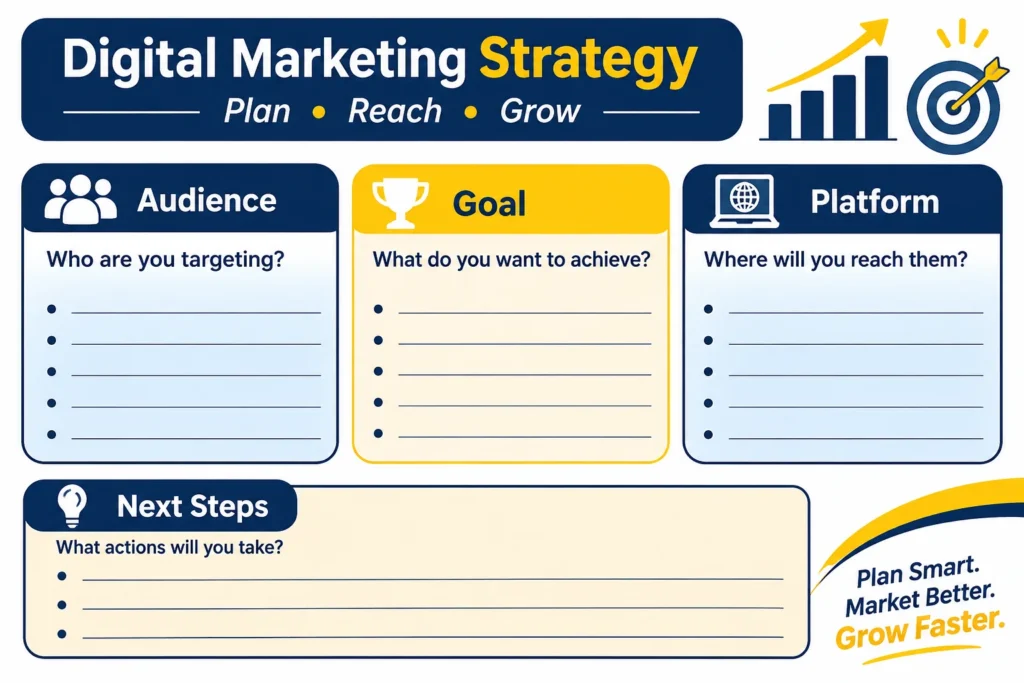
A strategy is just your plan. It provides solutions to three queries. For whom is this intended? What am I looking for? Where am I going to post?
Make your audience your top priority. Write a single sentence, such as “I assist [who] with [what].” Keep things easy. Next, choose a single goal for the next thirty days. One objective is sufficient. “Get more enquiries,” for instance. Next, imagine a single actual client. Consider their age, place of residence, challenges they face, and passions. Every post gets easier as that image gets clearer.
Now it’s time to pick your platform. Showing up where your target audience already congregates is the easiest rule I adhere to. Selling food or clothes? Start on Instagram, because people buy with their eyes. Offering a service, or working with other professionals? LinkedIn is the better starting point. And if you run a local shop, Facebook and Instagram together work well, since your neighbours are probably on both.
Still can’t decide? Don’t open any apps yet. Grab a notebook, answer the three questions, and then copy everything onto one page. That page is your strategy, and it’s much simpler than it sounds. I go into more detail in my guide on how to create a social media strategy.
Step 2: Choose Your Content Pillars

Content pillars are the three or four themes you post about again and again. They save you from asking, “What do I post today?” Every post fits one pillar.
Here’s an example for a clothing brand. Take a clothing brand. New arrivals, styling tips, behind-the-scenes, customer stories: any one of those can fill a week of posts. A local service has its own set. Before-and-after photos work well, so do quick tips and reviews, and don’t skip the questions customers ask again and again. Use the same pillars on every platform. I break this down in my social media marketing guide for beginners 2026.
Mix helpful posts with selling posts. Mostly teach, help or entertain. Sometimes they sell. That keeps your page from feeling like a constant advert.
The same idea works for blogs. I explain the blog version in my post on pillar and cluster content. For social media, I’ll cover it in my guide to social media content pillars.
Step 3: Build a Content Calendar
A content calendar is a simple schedule of what you’ll post and when. A spreadsheet works fine. So does a page in your notebook.
Give each post a row. Add the date, platform, content pillar, format and main message. Here’s a sample row: 12 November, Instagram, styling tips, reel, “3 ways to wear one scarf”, and “Save this post” as the call to action. Add a call to action to every row. A call to action, or CTA, is the next step you want people to take, like “Send us a message”.
Let’s explain the formats. A reel is a short vertical video. A carousel is a post people swipe through. A story is a quick post that disappears after 24 hours.
Start with two weeks, not ninety days. Plan, post, learn and adjust. Batch your work as well. Write all your captions in one day. Film on another. It’s much faster than doing everything daily.
My experience with social media content planning
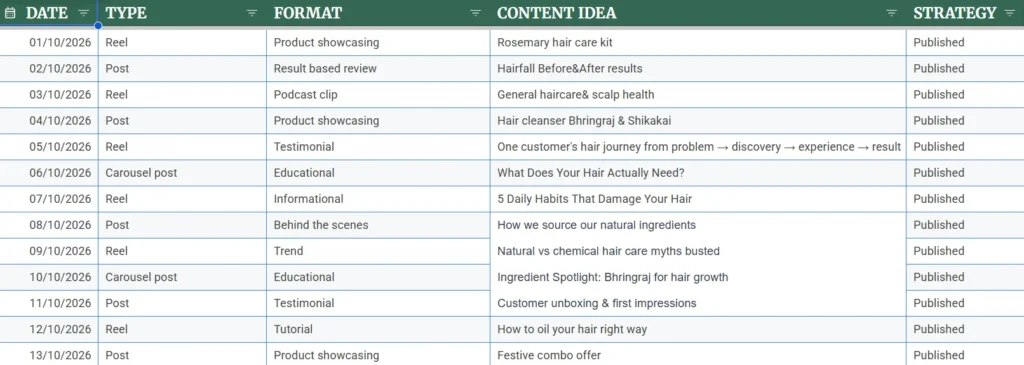
I haven’t run a live campaign yet, so I can’t tell you what results to expect. What I can tell you is how I planned one.
For a haircare brand, I prepared a competitor analysis and a 30-day content calendar.
The month had Dussehra in the middle, so the festive offer had to fit in. I mixed the posts on purpose: a product poster, an offer post, a customer’s WhatsApp feedback, and a four-week before-and-after result. Some posts were there to sell, and some were there to build trust. I added story ideas for the days as well.
Once the calendar goes live, I’ll check the reach and enquiries first and write about what happened.
Step 4: Create Posts and Reels
Now for the fun part. It’s time to make the content.
Start with a hook. A hook is whatever makes someone stop scrolling: the first line of a caption or the first second of a video. Be specific about what they’ll get. “3 mistakes killing your reach” beats “social media tips” every time.
Keep each reel to one idea. Add text on the screen too, since a lot of people watch with the sound off. And if you can, film near a window. Good light beats a fancy camera.
As for captions, just write as you talk. Use short lines. Share one idea. End with a CTA. Keep your look consistent too. Use the same colours and fonts. That helps people recognise you at a glance.
Here’s a time-saver. Reuse one idea in three ways. Turn it into a post, a reel and a story. It’s like cooking one big pot of food and serving it three ways.
Need ideas? Answer a common question. Show a before and after. Share one quick tip. Introduce your team. Show how something is made. Each one is easy to film on a phone. Follow this social media marketing guide for beginners 2026 step by step, and your first reel will feel much easier. I’ll share ideas in my list of reel ideas for small businesses.
Step 5: Track What Works
Posting without checking results is like running a stall without counting your sales. You’ll never know what’s working.
Every platform has built-in analytics. Analytics are the numbers that show how your posts performed. On Instagram, you can learn how to read them in the Instagram Help Center.
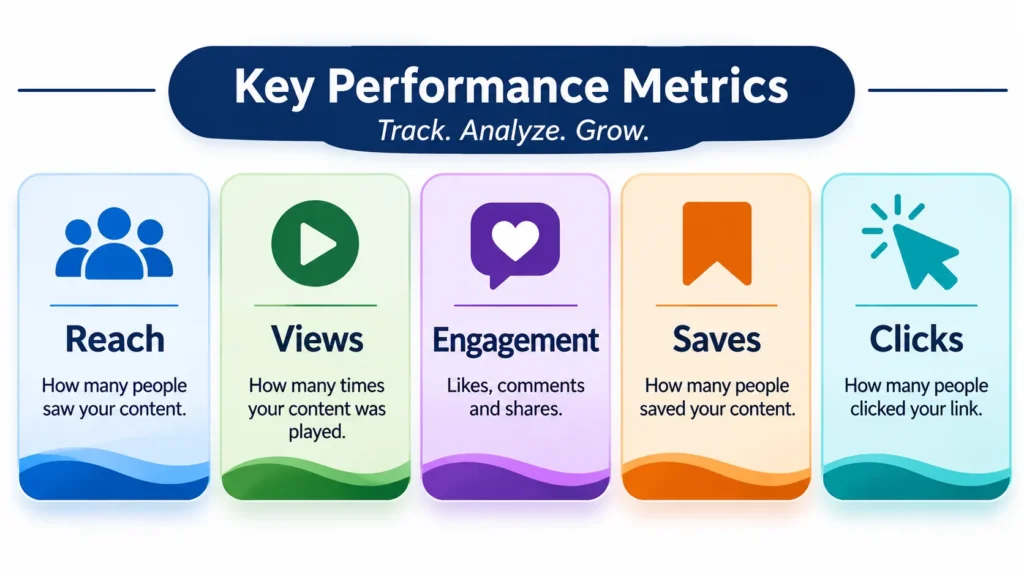
Start with these numbers:
Reach: how many different people saw your post.
Views (or impressions): every single time it was seen. If the same person watches twice, that’s two views.
Engagement: likes, comments, shares, saves.
Saves and shares: the ones I watch most closely. People only save a post when it helps them, so they tell you more than they ever will.
Clicks or messages: actions that move people toward your goal.
Check once a week. Note your best and worst posts. Ask why. Then do more of what worked. And don’t compare yourself with big accounts. Compare yourself with your own last month. A weekly check keeps this social media marketing guide for beginners 2026 practical. Ten minutes is enough.
I’ll explain these numbers in more detail in my guide to social media metrics to track.
Social Media Marketing Guide for Beginners 2026: FAQs
Which platform is best for beginners?
Start where people are currently spending time. That’s Instagram for a lot of brands. LinkedIn is frequently used by professionals and service companies. First, choose one platform. When the first seems simple, add a second.
How frequently should I publish?
Select a beat that you can maintain. For many novices, three to four postings each week is a reasonable starting point. Posting consistently is more important than posting daily.
How long until social media marketing pays off?
It varies. Some people see small signs in a few weeks. Growth often takes months. Keep tracking and keep improving.
Do I really need a content calendar?
You don’t have to, but it helps a lot. A calendar stops last-minute panic. It also shows you patterns in what works. If you follow this social media marketing guide for beginners 2026, a simple two-week calendar is enough.
Is this guide enough to get started?
Yes. It covers everything from planning to tracking. If you want more on any step, the deeper post is linked right there.
How do I know my posts are working?
Check it against your goal. Want more reach? Watch your views. Want sales? Count your enquiries and orders. If the number you care about goes up month after month, it’s working.
Conclusions on This Social Media Marketing Guide for Beginners 2026
Let’s recap this social media marketing guide for beginners 2026. Plan your strategy. Choose your content pillars. Build a calendar. Create your posts and reels. Track what works.
Here’s a simple first week. On day one, write your audience sentence and your goal. On day two, choose your platform. On day three, pick your pillars. On day four, plan two weeks of posts. On day five, make your first posts. On day six, publish. On day seven, check your numbers.
Avoid three common mistakes. Don’t post everywhere at once. Don’t post without a plan. And don’t forget to check your results.
That’s the whole social media marketing guide for beginners 2026 in five steps. Use this social media marketing guide for beginners 2026 as a monthly checklist. Begin modestly. Here’s your first small challenge. Start small. One platform, one goal, two weeks of posts. Then tell me what happened, even if it flopped. I’d rather hear the honest version.
Written by Remya Nair E, a digital marketing consultant in Thrissur, Kerala, who has completed hands-on social media marketing training and focuses on helping beginners and small businesses understand social media strategy, content creation, audience engagement, and online brand growth.
Pingback: How to Create a Social Media Strategy: 6 Simple Steps
Pingback: Content Pillars for Social Media: 5 Easy Steps to Choose