
A presence in search results for a small business when its products or services are being sought within the locality could be crucial. A possible customer may search for “best bakery near me,” “digital marketing consultant in Thrissur” or “dentist in Thrissur.”
With the possibility of reaching out to such a customer at the time he or she is seeking, you get better chances of having him or her place an order through a call, email inquiry, website visit or even a store visit.
That is why local keyword research is essential for small businesses.
Local keyword research enables you to know what your possible customers really search for, their locations, the kind of services they need and how they search for them. Rather than make assumptions about the kinds of keywords to include on your website, you get to base your efforts on the actual behavior of the searcher.
As a small business, ranking for as many keywords is not the aim but making local searches work to your advantage.
What Is Local Keyword Research?
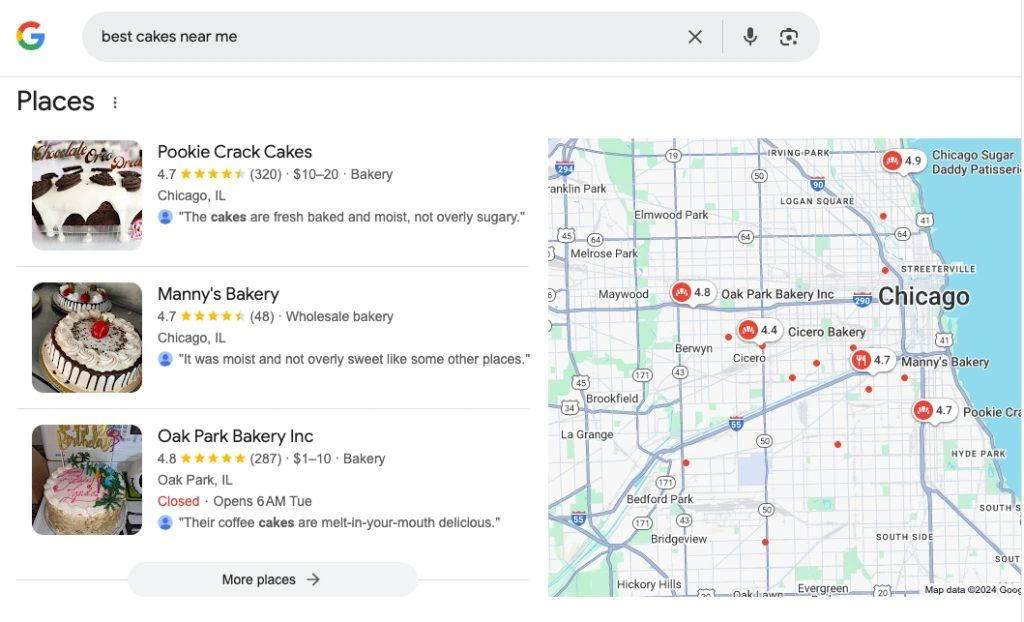
Local keyword research involves the identification and analysis of search terms that people employ while searching for services, products, or local businesses.
An example of keywords without location can be:
- Digital marketing consultant
- Bakery
- Dentist
- Interior designer
Adding location will result in search terms that will be more locally oriented as follows:
- Digital marketing consultant in Thrissur
- Bakery in Thrissur
- Dentist near Thrissur
- Interior designer in Thrissur
The phrase may also consist of such words as:
- Near me
- Nearby
- Open now
- Best
- Affordable
- In Thrissur
- Near Swaraj Round
- Near West Fort
What is really needed is to grasp the terms used by your customers to express their requirements.
Why Local Keyword Research Matters for Small Businesses
Small businesses generally have limited budgets and resources. Being in competition with large national brands for generic keywords is a tough challenge.
Local SEO offers a chance for a small business to target a more niche audience.
For instance, the competition for the keyword “digital marketing” would be extremely intense. The keyword “digital marketing consultant in Thrissur” is more specific and targeted.
Local keyword research can assist in:
- Understanding customers’ search behaviour
- Uncovering local opportunities
- Creating valuable local content
- Optimising services pages
- Optimising Google Business Profile
- Finding long-tail keywords
- Getting closer to converting customers
According to Google, their Local Search results depend mainly on the factors of relevance, distance, and prominence. Having complete and accurate business information makes Google know how your business is related to relevant searches.
This is the reason why keyword research should not be considered as a separate SEO task. Instead, it needs to complement your website, Google Business Profile, and local content strategy.
How Small Businesses Can Find Local Keywords
1.Identify Your Products and Services
Before you even open a keyword research tool, write down everything that your business provides.
Let us assume that you have a digital marketing business located in Thrissur.
Your first list could contain:
- SEO services
- Local SEO
- SMM
- Google ads
- Content marketing
- Digital marketing consultation
These are your seed keywords.
In case of a bakery, your list will have:
- Birthday cakes
- Marriage cakes
- Custom cakes
- Cupcakes
- Eggless cakes
- Cake delivery
This way, you start with your real services.
2. Add Your Location Naturally
The next thing would be to incorporate your services with suitable places.
Like:
Service + Place
- SEO expert in Thrissur
- Local SEO services in Thrissur
- Google Ads expert in Thrissur
- Social media marketing firm in Thrissur
You could also try other adjacent places that you truly cater to.
Like:
- SEO expert in Ayyanthole
- Digital marketing expert in Punkunnam
- SEO services around West Fort
- Digital marketing services in Ollur
But you do not need to create pages for each place just to fill them with keywords. The place needs to have business significance and content.
3. Think Like Your Customer
Local keywords are quite easy to research if you simply consider the query that your client would be typing in Google.
Consider the case where your customer wants a dentist.
The search queries include:
- Dentist near me
- Best dentist in Thrissur
- Dental clinic near me
- Emergency dentist Thrissur
- Affordable dental clinic in Thrissur
However, it is also important to note that your customer will not necessarily be looking for a dentist using the keyword “dentist.”
Your customer might be looking for something like the best dentist or affordable dentist or emergency dentist etc.
4. Use Google Search Suggestions
Google itself could provide some good starting points for conducting local keyword research.
Just enter your core service into the search engine and review the auto-completed suggestions.
For instance, try entering:
Digital marketing consultant in…
This way, you could find various combinations based on locations, services offered, or people’s intentions.
In addition, you could conduct a search with your core keyword and review the “People also ask” and suggested searches.
This way, you could see the questions and terms used by your target audience.
The objective is not to use all the suggestions. The goal is to find common themes.
5. Use Google Trends to Understand Search Interest

Google Trends will assist you in comparing your search interest and seeing how search interest evolves. You will be able to see what users search for and compare them.
The comparisons can be made like these:
- digital marketing agency
- digital marketing consultant
- SEO agency
- SEO consultant
Geographical analysis can also be performed when enough data is available.
Google Trends shouldn’t be considered a tool giving you the precise number of searches per month. Use it as a relative interest tool.
6. Find Long-Tail Local Keywords
Long-tail keywords generally consist of more targeted search queries.
For instance:
Broader term:
SEO
Narrower geographic term:
SEO services in Thrissur
Even more narrowed long-tail geographic term:
SEO services for small businesses in Thrissur at affordable prices
The reason why geographical long-tail searches are good is that they tell a lot about the user’s needs.
For instance:
SEO doesn’t provide any information on customers’ requirements.
But “affordable local SEO services for small businesses in Thrissur” does provide you with more details about the client’s requirements.
7. Understand Local Search Intent
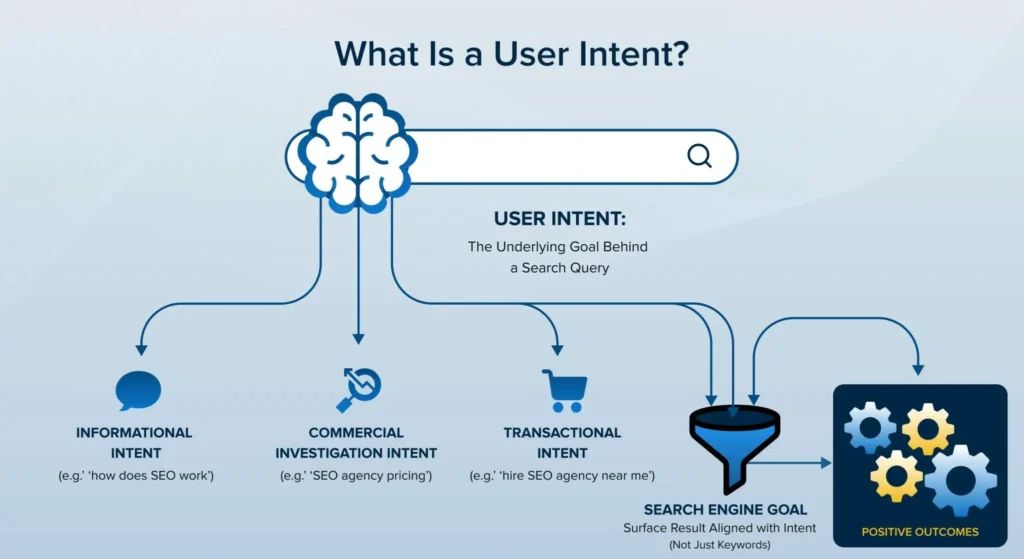
Not all keywords will have the same search intent.
Search intent is a crucial factor in local keyword research.
Informational intent
The user is looking for information.
Examples:
- What is local SEO?
- How does Google Business Profile work?
- How can you increase local search ranking?
Such keywords are suitable for blogs and guides.
Commercial investigation
The user is comparing various options.
Examples:
- Best SEO consultant in Thrissur
- Best digital marketing agency in Thrissur
- SEO services for small businesses
Such keywords can be suitable for comparison pages of services, case studies, and services content.
Transactional intent
The user is prepared to make an action.
Examples:
- Hire SEO consultant in Thrissur
- Digital marketing consultant near me
- Contact number for SEO agency
Such keywords are suitable for service and conversion-oriented pages.
Navigational intent
The user is looking for a certain business or website.
For instance:
- [Name of business] Thrissur
- [Name of business] contact
- [Name of business] reviews
Knowing all these intentions can help you place keywords on your website.
Where Should You Use Local Keywords?
Locating relevant keywords is just one half of the process. You must learn to use these keywords in a natural manner as well.
Use Local Keywords in Your Page Title
E.g. :
Digital Marketing Consultant in Thrissur |SEO & SMM
It gives immediate insight into the content of the webpage.
Use Them in Your H1
Your primary headline may read as:
Digital Marketing Consultant in Thrissur
It is unnecessary to repeat the same keyword again and again only for the purpose of increasing the density of keywords.
Use Them in Subheadings
The secondary headlines can be:
- Local SEO for Businesses in Thrissur
- SEO for Small Businesses
- Google My Business Listing
Use Them in Content
Don’t force your way with exact-match keywords into every paragraph.
According to Google’s Search Essentials, you should use the keywords that a person is likely to use when searching for your content in significant places like titles, headings, alt text, and link text.
Use Them in Image Alt Text
Rather than:
Alt text: image123.jpg
You can use:
Alt text: Digital marketing consultant speaking about local SEO to a small business owner
Always remember that alt text is to describe your image, not keyword stuffing.
Use Them in Internal Links
Internal links will assist the user and the search engine to find relevant pages on your website.
For instance, in the same article, you can link “Local SEO tips for small businesses” to your pillar page.
You may also link “Improve your Google Business Profile ranking” to your Google Business Profile cluster article.
Local Keyword Research and Google Business Profile
Keyword research would also determine the way you approach your Google Business Profile.
Google advises keeping the information on your Business Profile complete and accurate, from categories, working hours, location, and so forth. It also suggests engaging with the reviews and uploading pictures and videos.
But do not use the Business Profile as a place to list all the keywords you find.
The information that pertains to your business name, category, services offered, descriptions, website, and others must match what your business truly offers.
The objective here is relevance, not stuffing your Business Profile with keywords.
If you are a digital marketing consultant in Thrissur, your website and Business Profile must reflect your true offerings, not some unrelated search terms.
Build a Local Keyword Map
After collecting keywords, sort them into categories.
As follows:
| Keyword group | Example | Proposed Page |
| Primary service | Local SEO services | Service page |
| Location | SEO Consultant in Thrissur | Service location page |
| Informational | What is Geographical SEO? | Blog |
| Long-tail | Local SEO for Small Business | Cluster article |
| GBP | Improving Google Business Profile ranking | Cluster article |
| Commercial | Best SEO Consultant in Thrissur | Commercial Service content |
This technique is known as keyword mapping.
This avoids keyword cannibalization on your website by having many pages compete for the same keyword.
Common Local Keyword Research Mistakes
Keyword Stuffing
Repeating “local SEO consultant in Thrissur” in each and every paragraph will not make your content rank higher.
Always write to impress humans first.
Targeting Every Neighboring Location
You should not just create thin pages for every possible neighboring location because you discover a new location keyword.
Each location page must provide valuable location-specific information.
Ignoring Search Intent
Although your keyword might have search volume, it could be a non-relevant keyword for your business.
Always remember to consider:
“Will these keyword searchers really need the services/products I am offering?”
Focusing Solely on Search Volume
Search volume does not make a keyword a good one for a small business.
Low volume keywords which have high local and commercial intent might work better.
Using the Same Keyword Everywhere
There is a reason why there are homepages, service pages, blogs, and location pages.
Make a keyword map instead of having all pages target the same keyword.
How Local Keyword Research Supports Topical Authority
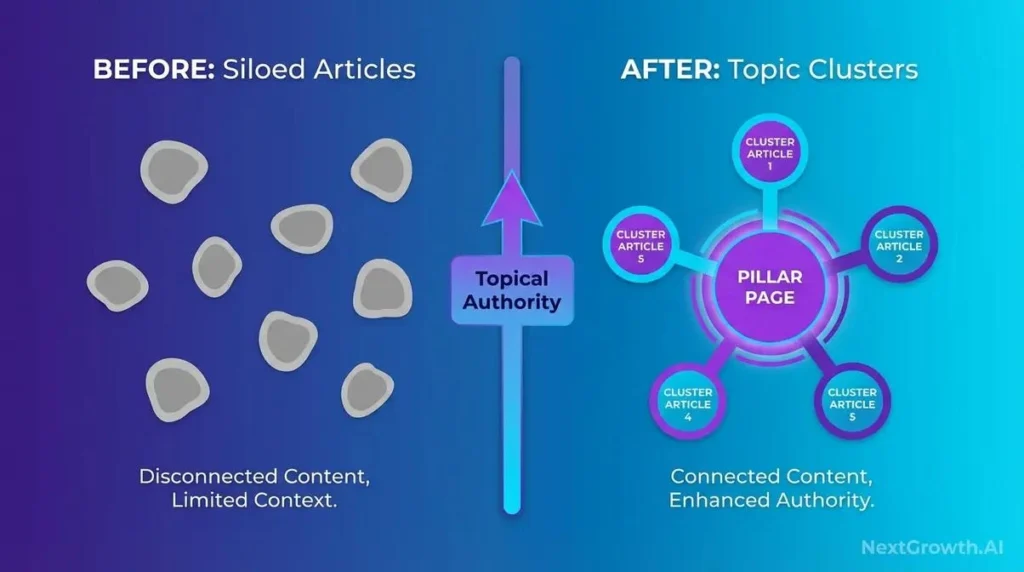
Local keyword research does not have to be limited to finding one main keyword.
It can allow you to establish topical authority.
The pillar topic on your website is:
Local SEO Guide for Small Businesses
You can create cluster content to support it, such as:
- How to Increase Your Google Business Profile Listing
- Local SEO Keyword Research for Small Businesses
- How to Get More Google Reviews
- Local Citations for Small Businesses
- Local SEO Analysis Checklist
- On-Page Optimization for Local Businesses
- Local SEO Content Strategies for Small Businesses
Every cluster page should address one particular local SEO aspect.
Then link these pages through internal links.
In that way, you get a logical structure of the content, where the pillar page contains the overall idea and the cluster pages have more detailed information.
A Simple Local Keyword Research Workflow
If you are a small business owner who does not know where to begin, then you should try following this easy procedure:
- Step 1: Enumerate your products and services.
- Step 2: Add your core service areas.
- Step 3: Do a search for your seed keywords on Google.
- Step 4: Write down autocomplete and associated keywords.
- Step 5: Use Google trends to compare related keywords.
- Step 6: Find out long tail keywords.
- Step 7: Categorize the keywords based on their intent.
- Step 8: Group similar keywords.
- Step 9: Match keywords with pages on your website.
- Step 10: Regularly check and change your keyword strategy.
The idea is not to generate hundreds of keywords. A limited number of highly relevant keywords may actually prove far more beneficial than an endless list of irrelevant keywords.
Conclusion
Local keyword research for small businesses serves as the cornerstone of any successful local SEO campaign and allows you to know your potential customers’ search behaviour, their needs, their location, and the type of information they are looking for.
For small businesses, the best keyword is not necessarily the one that has the highest number of searches. Usually, the best keyword is the one that bridges the three aspects – right customer, right service and right location.
Start from your services, understand your audience, research the language they use, and organize the resulting keywords based on search intent.
Use these findings naturally throughout your website, pages dedicated to each service, blog content, internal links, Google My Business listing, etc.
If you are developing a more comprehensive local SEO strategy, you could use this article as a cluster page to supplement your main guide, Local SEO Tips for Small Businesses.
In this case, together these pages will provide your readers with a stronger topical structure and allow them to make the way from general local SEO information to strategies that can be applied in practice.
But remember one thing – don’t write for search engines. Try to write the content that would answer the questions of your local customers. The content that would be useful, relevant, credible, and related to your expertise.
Pingback: Best Local SEO Tips for Small Businesses in 2026