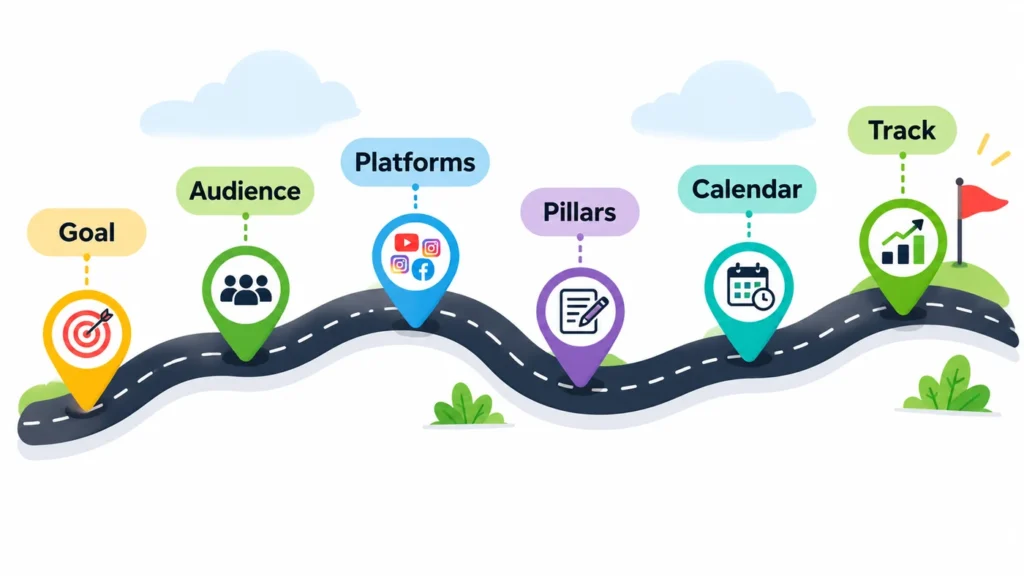
If you want to know how to create a social media strategy, start with one simple idea: a strategy is a map.
Written by Remya Nair E, a digital marketing consultant based in Thrissur, Kerala, who has completed hands-on social media marketing training and works with small businesses on their content and social media strategy.
Imagine a road trip without a map. You’d drive for hours. You’d take wrong turns. You might never arrive. Posting regularly without a clear strategy keeps you active, but not moving forward.
In this guide, I’ll show you how to create a social media strategy in six steps. You only need a notebook and about an hour. I’ll keep the words simple and explain each new term as we go.
This is the first post in my social media series. It supports my main social media marketing guide for beginners 2026. If you haven’t read it yet, start there for the big picture.
How to Create a Social Media Strategy: What It Is and Why It Matters
A documented plan outlining how you’ll use social media to accomplish a goal is called a social media strategy. It answers four questions. Who do you want to reach? What will you post? Where will you post? How will you check your results?
It doesn’t need to be long. One page is plenty for a small business. Here’s what one can look like for an imaginary bakery:
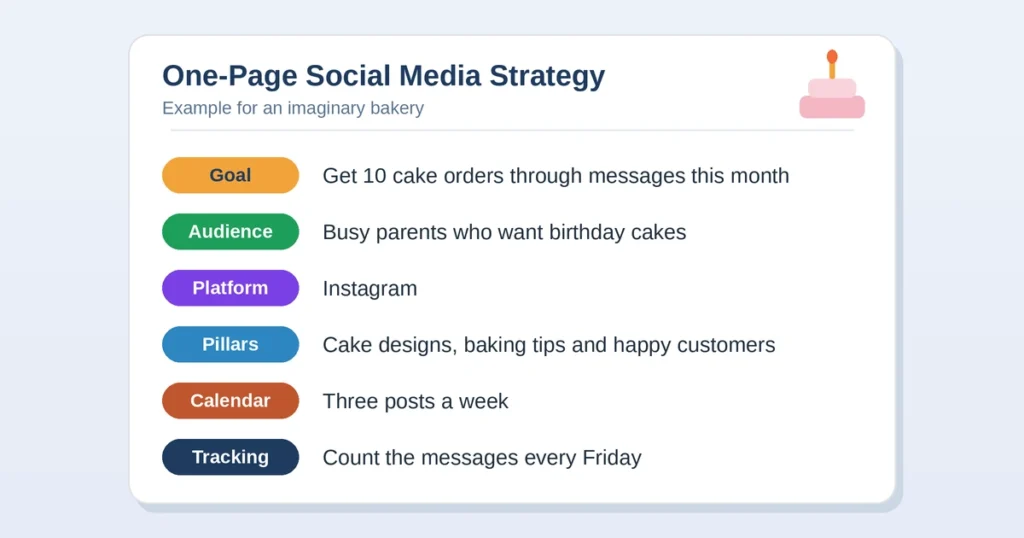
| Part of the plan | Example for the bakery |
| Goal | Get 10 cake orders through messages this month |
| Audience | Busy parents who want birthday cakes |
| Platform | |
| Content pillars | Cake designs, baking tips and happy customer |
| Calender | Three posts a week |
| Tracking | Count the messages every Friday |
So why bother? There are three good reasons. First, it saves time. You don’t have to decide from scratch every day. Secondly, it maintains consistency in your posts. Your fans are aware of what to anticipate. Thirdly, it demonstrates what is effective. You can get better when you monitor your progress.
You may avoid shiny-object syndrome by having a plan. That’s the urge to adopt every new app or fad. “Does this help my goal?” It’s the question you ask yourself when you have a clear strategy and direction; if not, leave it out.
If you’re new, knowing how to create a social media strategy helps you stop guessing. It isn’t about being fancy. It’s about being clear.
Step 1: Set One Clear Goal

Start with the goal. Everything else follows from it. A goal is the one result you want in a set time. Always start here when learning how to develop a social media plan.
For the following 30 days, choose one objective. Beginners often pick five. That spreads you too thin. Here are four common goals:
- Awareness: more people are aware of your brand.
- Engagement: more post interactions
- Leads: more people ask about your service.
- Sales: more people buy.
Now make your goal easy to measure. “Get more enquiries” is vague. “Get ten enquiries through Instagram messages this month” is clear. Begin by writing down your specific, measurable objective right at the top of your paper. Then check every future post against it.
Step 2: Know Your Audience
The demographic you wish to reach is known as your audience. Be specific. “Everyone” is not an audience.
When learning how to develop a social media strategy, understanding your audience is half the work. Describe one actual person first. Consider their age, place of residence, challenges they face, passions, and apps they utilise. We refer to this succinct description as a consumer persona. Assign a name to your persona to make it feel more realistic and relatable.
Where do you find the answers? You don’t need paid tools. Ask your current customers. Read the questions people send you. Check the comments on posts like yours. Look at who follows similar accounts. These are actual hints.
Have a few easy questions for yourself. What is it that they find difficult? What do they want to know? What would make them trust me? Your answers become post ideas.
Then finish with one sentence: “I help [who] with [what].” Keep it plain. This line guides every post you make.
Step 3: Pick Your Platforms

A platform is an app where you post, like Instagram, Facebook or LinkedIn. You don’t need all of them. To begin, choose one or two.
When learning how to develop a social media strategy, a lot of individuals hurry this step. Don’t. Choose where your audience already spends time, and where your content fits. Here’s a quick guide:
- Instagram: Looks matter here. Good for photos and short videos.
- Facebook: Local people, local news. Good for events and offers.
- LinkedIn: services and advice for professionals.
- YouTube: longer how-to videos.
Also be honest about your time. It’s better to water one plant well than four plants a little. Add a second platform only when the first feels easy.
Next, look at three similar businesses. This is called competitor research. What do they post? What gets comments? What are they missing? Don’t copy them. Learn from them. This is a quick win when you’re learning how to create a social media strategy.
Step 4: Choose Your Content Pillars
Content pillars are three or four themes you post about again and again. They answer the daily question, “What do I post today?” If you’re wondering how to create a social media strategy that you can actually follow every day, pillars are the answer.
Here’s an example for a clothing brand: new arrivals, styling tips, behind the scenes and customer stories. For a local service business, it could be before-and-after work, quick tips, customer reviews and answers to common questions.
Mix your posts. Mostly teach, help or entertain. Sometimes they sell. That keeps your page from feeling like a constant advert.
The same idea works for blogs. I explain the blog version in my post on pillar and cluster content. For social media, I go deeper in my guide to social media content pillars.
Step 5: Plan Your Content Calendar
Once you know how to create a social media strategy on paper, the calendar puts it into action. A content calendar is a straightforward timetable of your posts. It works well to use a page from a spreadsheet or notebook.
First, pick a beat that you can keep up. Three posts a week is a good starting point for many beginners. Daily posting is not as vital as regular publication.
Then give each post a row. Add the date, platform, content pillar, format and main message. Formats include posts, reels, carousels and stories. A reel is a short vertical video. A carousel is a post people swipe through. A story is a quick post that disappears after 24 hours.
Finally, add a call to action, or CTA. A CTA is the next step you want people to take, like “Send us a message”.
Plan only two weeks at first. That’s plenty for a beginner who is still learning how to create a social media strategy. Make your content in batches. Write captions on one day and film on another. It’s much faster. I show the full method in my guide on how to make a social media content calendar.
Step 6: Track Your Results and Adjust
Tracking is the last and most frequently disregarded phase in creating a social media plan. Posting without checking the results is like driving without using a map.
Every platform has built-in analytics. Analytics are the numbers that show how your posts performed. The Instagram Help Center has instructions on how to read them.
Start with the figures that correspond to your objective:
- Reach: the number of individuals who viewed your post.
- Likes, comments, shares, and saves are a few instances of involvement.
- Clicks and messages are acts that help you accomplish your objective.
Check once a week. Then review once a month. Ask three questions. What worked? What didn’t? What will I change? I explain more numbers in my guide to social media metrics to track.
Your strategy isn’t set in stone. After 30 days, update it. Sort your ideas into three piles. Keep what worked. Change what almost worked. Stop what didn’t. That’s how to create a social media strategy that keeps getting better.
How to Create a Social Media Strategy FAQs
What is a social media strategy in simple words?
Think of it as your plan on one page. It says what you want, who you’re talking to, where you’ll show up, what you’ll share and how you’ll know it’s working.
How long does it take to learn how to create a social media strategy?
Less time than you’d think. The first draft takes about an hour. Don’t aim for perfection. You’ll fix it as you see what your audience likes, so treat that first version as a rough sketch.
Can someone learn how to create a social media strategy without having to buy any tools?
Indeed, many people do. It’s sufficient to have a notepad or spreadsheet and your phone. Paid ads can wait until you know what works.
How many platforms ought I to utilise?
Begin with one or two. Select the locations where your target demographic already congregates. If you can’t keep up with a second platform, don’t add it yet. One platform you show up on is better than four you forget.
What should be included in a social media strategy?
A purpose, an audience, your channels, your content pillars, a content calendar, and a method to monitor outcomes are all essential components of a successful social media strategy. That’s sufficient to start. You can add more later on.
How often should I update my strategy?
Have a quick look once a month. Give it a proper refresh every three months. If your goal changes, update it sooner. It’s like checking the map on a long trip. You don’t stare at it all day, but you’d hate to miss a turn.
Are a content schedule and a strategy synonymous?
Not quite. The strategy is the why. The calendar is the what and when. You need both, but the calendar only makes sense once the strategy is in place.
Final Thoughts on How to Create a Social Media Strategy
Let’s recap. Set one clear goal. Know your audience. Pick your platforms. Choose your content pillars. Plan your calendar. Track and adjust.
Before you go, avoid these mistakes when you learn how to create a social media strategy. Don’t pick five goals. Don’t post on every platform. Don’t copy competitors word for word. And don’t skip the tracking step.
That’s how to create a social media strategy in six steps. Here’s your one-page template to copy: Goal. Audience. Platforms. Pillars. Calendar. Tracking. Fill in one line for each, and you’re ready to post.
Save this guide on how to create a social media strategy and come back to it each month. Then tell me how it went.
Pingback: Social Media Marketing Guide for Beginners 2026: 5 Steps
Pingback: Content Pillars for Social Media: 5 Easy Steps to Choose